Data-Driven Incentive Design
Optimizing incentives for taxi drivers using causal estimates of supply elasticity
Julian Streyczek, June 2026
This case study shows how to combine user data, causal inference, and optimization to design an incentive scheme. The example uses public data on taxi trips in San Francisco and designs a simple tiered rewards scheme to increase the number of trips completed by drivers.
This notebook is structured as follows. First, I load and clean the data. Second, I estimate individual labor supply, i.e. how drivers adjust the number of trips they complete when revenue per trip changes, using a same-day leave-one-out instrument for causal identification. Third, I explain how to use this estimate in a tiered incentive scheme and use a back-of-the-envelope calculation to simulate how many additional trips would be completed, along with the expected cost. Finally, I apply a simple optimization over potential reward levels to find the best design given a predefined budget.
The goal is not to claim that the result is the final optimal policy, but to show a practical data science workflow for solving a real-world objective.
Table of Contents
- Setting and Data
- Estimating Drivers' Supply Elasticity
- Tiered Incentive Scheme
- Optimization
1) Setting and Data
1.1 Objective
Imagine you are tasked with increasing the number of trips offered by taxi drivers in San Francisco. For example, you might want to increase market share compared to competitors or provide more reliable taxi coverage for residents and visitors. You have access to public DataSF Taxi Trips records on completed rides, including trip start and end date/time/location, driver IDs, and fare amounts.
1.2 Data
We'll start by loading the data and cleaning it in two layers. The first layer removes records that are physically impossible or missing key fields: trips without a valid driver ID or start time, non-positive fares, durations outside a one-minute-to-three-hour window, and implied speeds above 120 km/h. The second layer trims the most extreme 0.1% in each tail of fare, duration, and distance.
I then create driver-day and driver-week panels for the subsequent analysis, applying the same trip-level cleaning conventions to both. The driver-day panel will be used for the elasticity estimation, while the driver-week panel will be used to calibrate the incentive scheme. The driver-day panel additionally excludes major US holidays.
import os
from pathlib import Path

import re
import numpy as np
import pandas as pd
from pandas.tseries.holiday import USFederalHolidayCalendar
import matplotlib.pyplot as plt
import seaborn as sns
import statsmodels.formula.api as smf
from linearmodels.iv import IV2SLS

cwd = Path.cwd()
PROJECT_ROOT = cwd if (cwd / 'data' / 'raw').exists() else cwd.parent
RAW = PROJECT_ROOT / 'data' / 'raw'
OUTPUTS = PROJECT_ROOT / 'outputs'
OUTPUTS.mkdir(exist_ok=True)


pd.set_option('display.max_columns', 40)
pd.set_option('display.width', 140)
plt.rcParams.update({
    'figure.dpi': 120,
    'axes.spines.top': False,
    'axes.spines.right': False,
    'axes.grid': True,
    'grid.alpha': 0.25,
})

#print(f'Project root: {PROJECT_ROOT}')
# Define columns to be loaded
cols = [
    'driver_id',
    'start_time_local', 'end_time_local',
    'pickup_location_latitude', 'pickup_location_longitude',
    'fare_time_milliseconds', 'trip_distance_meters',
    'total_fare_amount'
]


# Load each month and concatenate into a pandas DataFrame
files_raw = sorted(f for f in os.listdir(RAW) if re.match('sf_taxi_trips_.+\\.csv', f))
parts = []
for fn in files_raw:
    df = pd.read_csv(RAW / fn, usecols=lambda c: c in cols, low_memory=False)
    df['source_file'] = fn
    parts.append(df)
src = pd.concat(parts, ignore_index=True);
del cols, files_raw, parts, fn


# Fix data types and create features
src['start']            = pd.to_datetime(src['start_time_local'], errors='coerce')
src['end']              = pd.to_datetime(src['end_time_local'], errors='coerce')
src['date']             = src['start'].dt.normalize()
src['pickup_hour']      = src['start'].dt.hour

src['trip_hours']       = (src['end'] - src['start']).dt.total_seconds() / 3600
fallback_hours          = pd.to_numeric(src['fare_time_milliseconds'], errors='coerce') / 3_600_000
src['trip_hours']       = src['trip_hours'].where(src['trip_hours'].between(1 / 60, 3), fallback_hours)

src['distance_km']      = pd.to_numeric(src['trip_distance_meters'], errors='coerce') / 1000
src['lat']              = pd.to_numeric(src['pickup_location_latitude'], errors='coerce')
src['lon']              = pd.to_numeric(src['pickup_location_longitude'], errors='coerce')
src['speed_kmh']        = src['distance_km'] / src['trip_hours']

src['fare']             = pd.to_numeric(src['total_fare_amount'], errors='coerce')
src['revenue_per_hour'] = src['fare'] / src['trip_hours']
src['revenue_per_km']   = src['fare'] / src['distance_km']


# ── Trip-level cleaning ───────────────────────────────────────────────────
# Layer 1: validity filters removing missing or physically impossible records
valid_driver_id = src['driver_id'].notna() & src['driver_id'].astype(str).str.strip().ne('-')
valid = (
    valid_driver_id
    & src['start'].notna()
    & (src['fare'] > 0)
    & (src['trip_hours'] >= 1/60) & (src['trip_hours'] <= 3)
    & (src['distance_km'] >= 0)
    & (src['speed_kmh'] <= 120)
)

# Layer 2: symmetric quantile trim of the analysis variables among valid trips
TRIM_Q = 0.001
trip_trim_cols = ['fare', 'trip_hours', 'distance_km']
trip_trim_bounds = src.loc[valid, trip_trim_cols].quantile([TRIM_Q, 1 - TRIM_Q])
keep = valid.copy()
for col in trip_trim_cols:
    keep &= src[col].between(trip_trim_bounds.loc[TRIM_Q, col], trip_trim_bounds.loc[1 - TRIM_Q, col])

basic = src[keep].copy()
basic['driver_trip_count'] = basic.groupby('driver_id').transform('size')
# ── Driver-day panel (for IV estimation) ─────────────────────────────────
driver_day = (
    basic.groupby(['driver_id', 'date'])
    .agg(
        daily_trips   =('fare',      'count'),
        daily_hours   =('trip_hours','sum'),
        daily_earnings=('fare',      'sum'),
    )
    .reset_index()
)
driver_day['revenue_per_trip']  = driver_day['daily_earnings'] / driver_day['daily_trips']
driver_day['weekday'] = driver_day['date'].dt.dayofweek
driver_day['ym']      = driver_day['date'].dt.to_period('M').astype(str)
# Exclude major US holidays: federal holidays plus Christmas Eve and New Year's Eve.
holiday_dates = (
    USFederalHolidayCalendar()
    .holidays(start=driver_day['date'].min(), end=driver_day['date'].max())
    .union(pd.to_datetime([
        f'{year}-12-{day}'
        for year in range(driver_day['date'].dt.year.min(), driver_day['date'].dt.year.max() + 1)
        for day in (24, 31)
    ]))
)

# Active days only: At least 3 trips, maximum 20 hours
keep_day = (driver_day['daily_trips'] >= 3) & (driver_day['daily_hours'] <= 20)
on_holiday = driver_day['date'].isin(holiday_dates)
driver_day = driver_day[keep_day & ~on_holiday].reset_index(drop=True)

driver_day['log_trips'] = np.log(driver_day['daily_trips'])
driver_day['log_rpt']   = np.log(driver_day['revenue_per_trip'])


# Week fields for driver-week aggregation
basic['year_week']  = basic['start'].dt.strftime('%G-W%V')
basic['week_start'] = pd.to_datetime(basic['year_week'] + '-1', format='%G-W%V-%u')


# ── Driver-week panel (for tier calibration and simulation) ───────────────
dw_raw = (
    basic.groupby(['driver_id', 'year_week'])
    .agg(
        weekly_trips   =('fare',      'count'),
        weekly_hours   =('trip_hours','sum'),
        weekly_earnings=('fare',      'sum'),
        active_days    =('date',      'nunique'),
    )
    .reset_index()
)
week_to_ym = (
    basic.groupby('year_week')['week_start'].first()
    .dt.to_period('M').astype(str)
    .rename('ym')
)
dw_raw = dw_raw.join(week_to_ym, on='year_week'); del week_to_ym
dw_raw['revenue_per_trip']  = dw_raw['weekly_earnings'] / dw_raw['weekly_trips']
dw_raw['earnings_per_hour'] = dw_raw['weekly_earnings'] / dw_raw['weekly_hours']
dw_raw['trips_per_hour']    = dw_raw['weekly_trips'] / dw_raw['weekly_hours']

# Active weeks only, then trim above the 99.9th percentile of the analysis
# variables; trips per hour catches weeks whose trips and hours are
# individually plausible but mutually inconsistent.
dw_active = dw_raw[dw_raw['weekly_trips'] >= 3]
week_trim_cols = ['weekly_trips', 'weekly_hours', 'weekly_earnings', 'trips_per_hour']
week_trim_caps = dw_active[week_trim_cols].quantile(1 - TRIM_Q)
driver_week = dw_active[(dw_active[week_trim_cols] <= week_trim_caps).all(axis=1)].reset_index(drop=True)
# Print descriptive statistics
print(f"Number of raw trips:        {len(src):,}")
print(f"Number of clean trips:      {len(basic):,}")
print(f"Period:                     {min(basic['date']):%Y-%m-%d} - {max(basic['date']):%Y-%m-%d}")
print(f"Drivers:                    {basic['driver_id'].nunique():,}")
print(f"Days:                       {(max(basic['date']) - min(basic['date'])).days + 1}")
print(f"Driver-day observations:    {len(driver_day):,}")
print(f"Driver-week observations:   {len(driver_week):,}")
Number of raw trips:        4,129,068
Number of clean trips:      3,809,871
Period:                     2022-12-01 - 2024-05-31
Drivers:                    1,384
Days:                       548
Driver-day observations:    323,067
Driver-week observations:   67,155
1.3 Summary statistics
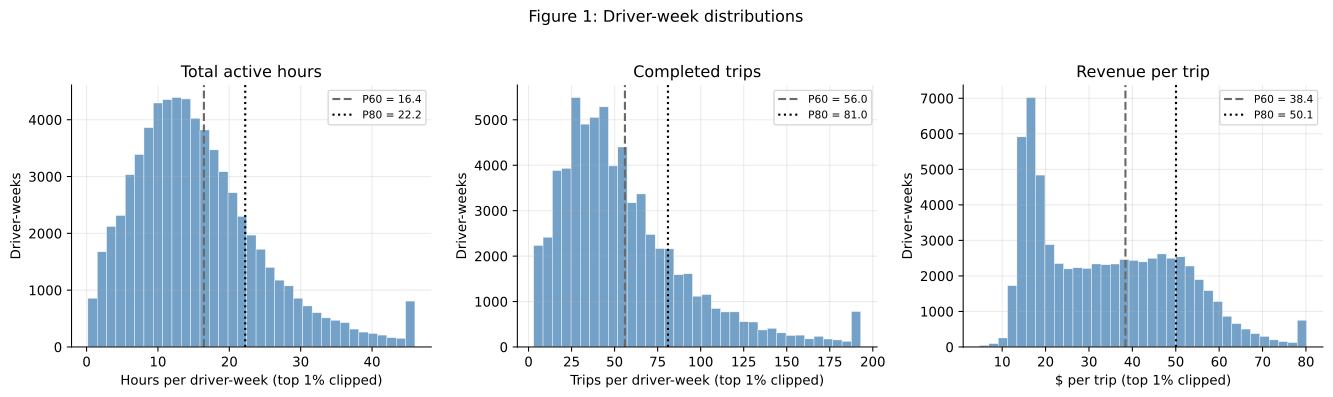
The average driver completes around 56 trips per week over 5.4 active days, for a total driving duration of just under 16 hours. Average revenue per trip is around 34.4 dollars, and average revenue per hour is around 108 dollars. While we do not know how trip revenue compares to driver compensation, for the purpose of this exercise I assume that revenue per trip is proportional to drivers' wage per trip.
summary_cols = [
    'weekly_trips', 'weekly_hours', 'weekly_earnings',
    'active_days',
     'revenue_per_trip', 'earnings_per_hour'
]
print(driver_week[summary_cols].describe().round(2).to_string())
       weekly_trips  weekly_hours  weekly_earnings  active_days  revenue_per_trip  earnings_per_hour
count      67155.00      67155.00         67155.00     67155.00          67155.00           67155.00
mean          56.14         15.73          1636.65         5.38             34.35             107.51
std           38.94          9.30           946.92         1.75             17.19              30.65
min            3.00          0.18            14.35         1.00              4.78              20.11
25%           29.00          9.21           933.22         4.00             18.36              80.53
50%           47.00         14.25          1510.90         6.00             32.32             105.99
75%           73.00         20.42          2192.43         7.00             47.19             129.00
max          291.00         66.35          6444.15         7.00            171.57             562.94
1.4 Descriptive figures
I plot the key variables for the analysis: weekly hours, weekly trips, and revenue per trip. The distributions are right-skewed, with a long tail of high-activity drivers (clipped at the 99th percentile). I highlight the 60th and 80th percentiles. Overall, there is a wide variation in driver activity, which motivates the use of different incentive tiers to target different segments of the driver population.
fig, axes = plt.subplots(1, 3, figsize=(14, 4))

vars_cfg = [
    ('weekly_hours',  'Total active hours',  'Hours per driver-week'),
    ('weekly_trips',  'Completed trips',      'Trips per driver-week'),
    ('revenue_per_trip', 'Revenue per trip',  '$ per trip'),
]

for ax, (col, title, xlabel) in zip(axes, vars_cfg):
    p60 = driver_week[col].quantile(0.60)
    p80 = driver_week[col].quantile(0.80)
    plot_cap = driver_week[col].quantile(0.99)
    plot_values = driver_week[col].clip(upper=plot_cap)
    sns.histplot(plot_values, bins=35, color='steelblue', edgecolor='white', linewidth=0.3, ax=ax)
    ax.axvline(p60, color='dimgray', lw=1.6, linestyle='--', label=f'P60 = {p60:.1f}')
    ax.axvline(p80, color='black', lw=1.6, linestyle=':', label=f'P80 = {p80:.1f}')
    ax.set(title=title, xlabel=f'{xlabel} (top 1% clipped)', ylabel='Driver-weeks')
    ax.legend(fontsize=8)

fig.suptitle('Figure 1: Driver-week distributions', y=1.03)
fig.tight_layout()
fig.savefig(OUTPUTS / '01_driver_distributions.svg', bbox_inches='tight')
plt.close(fig)
print('Figure saved: outputs/01_driver_distributions.svg')
Figure saved: outputs/01_driver_distributions.svg
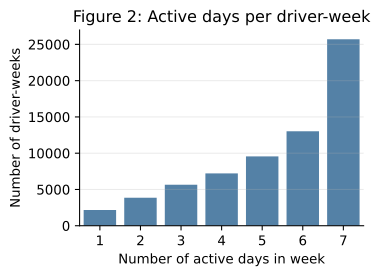
I also plot the number of active days per driver-week. Around half of drivers are active for all 7 days, while only a few work fewer than 5 days. Therefore, baseline activity is already quite high, so the main margin for increasing trips is likely on the intensive rather than extensive margin, i.e., increasing the number of trips per active day rather than increasing the number of active days.
fig, ax = plt.subplots(figsize=(4, 3))
active_day_order = np.arange(1, int(driver_week['active_days'].max()) + 1)
sns.countplot(data=driver_week, x='active_days', order=active_day_order,
              color='steelblue', linewidth=0, ax=ax)
ax.set(
    title='Figure 2: Active days per driver-week',
    xlabel='Number of active days in week',
    ylabel='Number of driver-weeks',
)
fig.tight_layout()
fig.savefig(OUTPUTS / '02_active_days_distribution.svg', bbox_inches='tight')
plt.close(fig)
print('Figure saved: outputs/02_active_days_distribution.svg')
Figure saved: outputs/02_active_days_distribution.svg
2) Estimating Drivers' Supply Elasticity
To design effective incentives, we need to understand how drivers adjust their labor supply with respect to their earning opportunities ("wage"). Next, I will outline the key decisions on measurement, empirical strategy, and identification.
2.1 Measurement
I measure labor supply using the number of completed trips, and I measure wage using revenue per trip.
Using completed trips has three advantages. First, it functions as a revealed measure of effort, since more availability and more effort selecting good zones for trips likely lead to more trips, but it does not reward idle time. Second, this measure is directly linked to the platform's ultimate goal: more trips mean more service to customers and more revenue for the platform. Third, it is easy for drivers to understand and for the firm to measure. However, it is important to keep drawbacks in mind: drivers may adjust by targeting shorter trips, so trip distance and duration should be monitored as well.
Using revenue per trip as the wage measure is a simplification. I assume that wage is proportional to revenue per trip, i.e., that drivers are incentivized by trip revenue. This is likely an important component in driver compensation. Moreover, when choosing whether to supply the next trip, the expected earning of that next trip is likely a key input in decision-making.
2.2 Empirical Strategy
I use a log-log regression of log number of trips on log revenue per trip at the driver-day level.
Aggregating to a driver-day panel captures the intensive margin of labor supply: the number of trips per day for drivers active on that day. I restrict the sample to days on which drivers are active, i.e., complete at least 3 trips. For simplicity, I do not model the extensive margin here, but it would be a worthwhile expansion in practice.
For estimation, I assume a constant supply elasticity: for a given percentage increase in "wage", the percentage increase in "supply" will be the same regardless of the baseline level. This is a common assumption in labor economics and provides a simple way to summarize the responsiveness of supply to changes in earnings. Empirically, this relationship is captured well by a log-log regression, where the coefficient on log revenue per trip directly gives us the approximate elasticity of supply.
The baseline estimating equation is as follows.
$$ \log Trips_{id} = \varepsilon \cdot \log RPT_{id} + Driver_i + Weekday_{d} + YearMonth_{m(d)} + u_{id} $$
where $Trips_{id}$ is the number of completed trips by driver $i$ on date $d$, and $RPT_{id}$ is the driver's revenue per trip on that day. Driver fixed effects absorb persistent differences in driver intensity, weekday fixed effects absorb regular weekly patterns, and year-month fixed effects absorb lower-frequency demand and seasonality differences. Since we exploit day-level variation, we cluster standard errors by date to account for potential correlation in unobserved demand shocks across drivers on the same day.
2.3 Identification via Hausman-Style Instrumental Variable
The OLS regression above is likely biased because omitted factors may drive both revenue per trip and number of trips. For example, on days with high demand, drivers may complete more trips but face lower revenue per trip due to higher competition and less favorable trip mix, leading to a negative correlation in OLS.
Therefore, I use a same-day leave-one-out instrument that uses variation in city-wide earning conditions to isolate exogenous variation in drivers' own earning opportunities. In particular, I instrument drivers' own revenue per trip with the average revenue per trip of all other drivers on the same day. Intuitively, if conditions are good for other drivers, they are likely good for the given driver as well. However, the leave-one-out construction ensures that the instrument is not mechanically correlated with the driver's own revenue per trip, helping to satisfy the exclusion restriction.
Mathematically, for each driver-day, I construct the instrument as follows:
$$ LOO\_RPT_{id} = \frac{\sum_{j \neq i} RPT_{jd}}{N_d - 1} $$
The two-stage least squares design is:
$$ \begin{aligned} \log Trips_{id} &= \varepsilon \cdot \log \widehat{RPT}_{id} + Driver_i + Weekday_d + YearMonth_{m(d)} + u_{id} \\ \log RPT_{id} &= \pi \cdot \log LOO\_RPT_{id} + Driver_i + Weekday_d + YearMonth_{m(d)} + v_{id} \end{aligned} $$
The coefficient $\varepsilon$ is the local average treatment effect of revenue per trip, i.e., the elasticity of supply with respect to revenue per trip, for the marginal driver whose revenue per trip is affected by city-wide earning conditions.
The identification assumption is that other drivers' same-day earning opportunities affect a given driver's trips only through that driver's own earning opportunity, conditional on fixed effects. While this is likely an improvement over the initial OLS specification, the design may still be subject to some bias. For example, if drivers observe demand shocks directly (e.g., through shared communication or by visual cues) and adjust their labor supply accordingly, day-level shocks may drive both the instrument and the outcome. In practice, one would therefore want to complement this design by adding flexible controls, exploiting natural experiments such as policy changes, or introducing experimental variation in trip revenues directly.
2.4 Estimation
Before estimating, I drop the most atypical market days. For each date, I compute the city-wide mean of log revenue per trip, residualize it on the weekday and year-month fixed effects of the model, and exclude days in the extreme 1% tails on both sides. The justification mirrors the holiday exclusion: identification relies on drivers not observing city-wide shocks directly, and the days with the most extreme market-wide conditions are precisely those where this assumption is least credible. Because the rule conditions only on instrument-side market conditions and is symmetric, it trims the support of the instrument rather than selecting on outcomes. Reassuringly, the excluded days have clear interpretations: the upper tail consists of arrival weekends of the city's largest conventions, while the lower tail consists of holiday-adjacent travel lulls, such as the day before Thanksgiving and the July 4th weekend.
I estimate the 2SLS model using the linearmodels package, adding OLS estimates for comparison. For computational reasons, I residualize before estimation, i.e., demean by fixed effects, which speeds up computations while providing the same coefficient estimates and standard errors. I report coefficient estimates along with standard errors, adjusted R-squared for OLS, and the built-in linearmodels partial first-stage diagnostic for IV specifications.
# Calculate equal-weight LOO-IV: average revenue per trip among other active drivers, then log.
day_sum = driver_day.groupby('date')['revenue_per_trip'].transform('sum')
day_cnt = driver_day.groupby('date')['log_rpt'].transform('count')
loo_eq_rpt = (day_sum - driver_day['revenue_per_trip']) / (day_cnt - 1)
driver_day['log_loo_eq_rpt'] = np.log(loo_eq_rpt)

dd = (
    driver_day[day_cnt >= 2]
    .dropna(subset=['log_trips', 'log_rpt', 'log_loo_eq_rpt'])
    .pipe(lambda df: df[np.isfinite(df['log_loo_eq_rpt'])])
    .copy()
    .reset_index(drop=True)
)

# Drop the most atypical market days: residualize the day-level mean of log
# revenue per trip on the model's calendar fixed effects and trim the extreme
# 1% tails. City-wide shocks of this size (convention arrival weekends,
# holiday-adjacent travel lulls) are directly observable to drivers, which is
# when the exclusion restriction is least credible. The rule conditions only
# on instrument-side market conditions, so it trims the support of the
# instrument rather than selecting on outcomes.
DAY_TRIM_Q = 0.01
day_conditions = (
    dd.groupby('date')
    .agg(day_log_rpt=('log_rpt', 'mean'), weekday=('weekday', 'first'), ym=('ym', 'first'))
    .reset_index()
)
day_conditions['resid'] = smf.ols('day_log_rpt ~ C(weekday) + C(ym)', data=day_conditions).fit().resid
typical_days = day_conditions.loc[
    day_conditions['resid'].between(
        day_conditions['resid'].quantile(DAY_TRIM_Q),
        day_conditions['resid'].quantile(1 - DAY_TRIM_Q),
    ),
    'date',
]
dd = dd[dd['date'].isin(typical_days)].reset_index(drop=True)


# Within-transform: absorb driver FEs via demeaning (avoids ~1,338-column design matrix)
for col in ['log_trips', 'log_rpt', 'log_loo_eq_rpt']:
    dd[f'{col}_w'] = dd[col] - dd.groupby('driver_id')[col].transform('mean')

clust = dd['date']

# ── helpers ───────────────────────────────────────────────────────────────────
def stars(p):
    if p < 0.01: return '***'
    if p < 0.05: return '**'
    if p < 0.10: return '*'
    return ''

def fmt(coef, se, pval):
    return f'{coef:.3f}{stars(pval)}', f'({se:.3f})'

def run_iv(fe_terms, data, clusters):
    fe = (f' + {fe_terms}') if fe_terms else ''
    iv = IV2SLS.from_formula(
        f'log_trips_w ~ 1{fe} + [log_rpt_w ~ log_loo_eq_rpt_w]', data=data
    ).fit(cov_type='clustered', clusters=clusters)
    first_stage = iv.first_stage.diagnostics.loc['log_rpt_w']
    return iv, first_stage['f.stat']

# ── OLS ───────────────────────────────────────────────────────────────────────
ols1 = smf.ols('log_trips_w ~ log_rpt_w',                      data=dd).fit(cov_type='cluster', cov_kwds={'groups': clust})
ols2 = smf.ols('log_trips_w ~ log_rpt_w + C(weekday)',         data=dd).fit(cov_type='cluster', cov_kwds={'groups': clust})
ols3 = smf.ols('log_trips_w ~ log_rpt_w + C(weekday) + C(ym)', data=dd).fit(cov_type='cluster', cov_kwds={'groups': clust})

# ── IV ────────────────────────────────────────────────────────────────────────
iv1, iv1_fs = run_iv('',                   dd, clust)
iv2, iv2_fs = run_iv('C(weekday)',         dd, clust)
iv3, iv3_fs = run_iv('C(weekday) + C(ym)', dd, clust)

ELASTICITY = float(iv3.params['log_rpt_w'])

# ── FE-residualized arrays for binscatter (Frisch-Waugh) ─────────────────────
_fe = 'C(weekday) + C(ym)'
_y  = smf.ols(f'log_trips_w      ~ {_fe}', data=dd).fit().resid.values
_x  = smf.ols(f'log_rpt_w        ~ {_fe}', data=dd).fit().resid.values
_z  = smf.ols(f'log_loo_eq_rpt_w ~ {_fe}', data=dd).fit().resid.values
_b1 = float(np.dot(_z, _x) / np.dot(_z, _z))
full_spec = {
    'y': _y, 'x': _x, 'z': _z, 'x_hat': _z * _b1,
    'ols_coef':      float(ols3.params['log_rpt_w']),
    'iv_coef':       ELASTICITY,
    'first_stage_stat': iv3_fs,
    'nobs':          int(iv3.nobs),
}
2.5 Results
The preferred specification, IV (6), suggests a supply elasticity of around 0.9, meaning that a one-percent increase in revenue per trip leads to an approximately 0.9 percent increase in the number of completed trips. The estimate is significant at the one-percent level, and the first-stage diagnostic statistic suggests a strong first stage, meaning that the instrument captures meaningful variation in earnings opportunities (although a robust F-statistic like Kleibergen-Paap would be the ideal diagnostic). The sign and magnitude of the estimate are consistent with economic theory, which predicts that higher wages increase labor supply. By contrast, the OLS estimates confirm the necessity of using a causal design, as the pure correlation between trips and revenue per trip is negative, suggesting that omitted variables produce a spurious correlation, even after controlling for high-dimensional fixed effects. For example, on days with high demand, drivers may complete more trips but face lower revenue per trip due to higher competition and less favorable trip mix, leading to a negative correlation in OLS.
# ── results table ─────────────────────────────────────────────────────────────
Y, N = 'Yes', ''

def row_ols(m, fe_flags):
    c, s = fmt(m.params['log_rpt_w'], m.bse['log_rpt_w'], m.pvalues['log_rpt_w'])
    return [c, s, '', f'{int(m.nobs):,}', f'{m.rsquared_adj:.3f}'] + fe_flags

def row_iv(m, first_stage_stat, fe_flags):
    c, s = fmt(float(m.params['log_rpt_w']), float(m.std_errors['log_rpt_w']), float(m.pvalues['log_rpt_w']))
    return [c, s, f'{first_stage_stat:.0f}', f'{int(m.nobs):,}', ''] + fe_flags

table = pd.DataFrame({
    '':          ['Elasticity', '(SE)', 'First-stage stat.', 'N', 'Adj. R2', 'Driver FE', 'Weekday FE', 'Year-month FE'],
    'OLS (1)': row_ols(ols1, [Y, N, N]),
    'OLS (2)': row_ols(ols2, [Y, Y, N]),
    'OLS (3)': row_ols(ols3, [Y, Y, Y]),
    'IV (4)':  row_iv(iv1, iv1_fs, [Y, N, N]),
    'IV (5)':  row_iv(iv2, iv2_fs, [Y, Y, N]),
    'IV (6)':  row_iv(iv3, iv3_fs, [Y, Y, Y]),
})

print('Table 1: Driver-Day Supply Elasticity Estimates')
print()
print('Dependent Variable: Log(Number of Trips)')
print(table.to_string(index=False))
print()
print('Notes: SE clustered by date. Significance: * p<0.10,  ** p<0.05,  *** p<0.01')
print('First-stage stat. is linearmodels first_stage.diagnostics f.stat.')

# ── save ──────────────────────────────────────────────────────────────────────
model_summary = pd.DataFrame([
    {'spec': n, 'estimator': est, 'Log(Revenue per Trip)': e, 'se': s, 'p_value': p, 'first_stage_stat': fs, 'adj_r2': r2, 'nobs': nobs}
    for n, est, e, s, p, fs, r2, nobs in [
        ('OLS (1)', 'OLS', ols1.params['log_rpt_w'], ols1.bse['log_rpt_w'],       ols1.pvalues['log_rpt_w'], np.nan, ols1.rsquared_adj, int(ols1.nobs)),
        ('OLS (2)', 'OLS', ols2.params['log_rpt_w'], ols2.bse['log_rpt_w'],       ols2.pvalues['log_rpt_w'], np.nan, ols2.rsquared_adj, int(ols2.nobs)),
        ('OLS (3)', 'OLS', ols3.params['log_rpt_w'], ols3.bse['log_rpt_w'],       ols3.pvalues['log_rpt_w'], np.nan, ols3.rsquared_adj, int(ols3.nobs)),
        ('IV (4)',  'IV',  iv1.params['log_rpt_w'],  iv1.std_errors['log_rpt_w'], iv1.pvalues['log_rpt_w'], iv1_fs, np.nan, int(iv1.nobs)),
        ('IV (5)',  'IV',  iv2.params['log_rpt_w'],  iv2.std_errors['log_rpt_w'], iv2.pvalues['log_rpt_w'], iv2_fs, np.nan, int(iv2.nobs)),
        ('IV (6)',  'IV',  iv3.params['log_rpt_w'],  iv3.std_errors['log_rpt_w'], iv3.pvalues['log_rpt_w'], iv3_fs, np.nan, int(iv3.nobs)),
    ]
])
model_summary.to_csv(OUTPUTS / 'driver_day_model_summary.csv', index=False)
Table 1: Driver-Day Supply Elasticity Estimates

Dependent Variable: Log(Number of Trips)
                    OLS (1)   OLS (2)   OLS (3)    IV (4)    IV (5)   IV (6)
       Elasticity -0.483*** -0.486*** -0.470*** -0.407*** -0.532*** 0.898***
             (SE)   (0.006)   (0.006)   (0.005)   (0.148)   (0.147)  (0.183)
First-stage stat.                                    3170      3106     1278
                N   316,485   316,485   316,485   316,485   316,485  316,485
          Adj. R2     0.109     0.115     0.153
        Driver FE       Yes       Yes       Yes       Yes       Yes      Yes
       Weekday FE                 Yes       Yes                 Yes      Yes
    Year-month FE                           Yes                          Yes

Notes: SE clustered by date. Significance: * p<0.10,  ** p<0.05,  *** p<0.01
First-stage stat. is linearmodels first_stage.diagnostics f.stat.
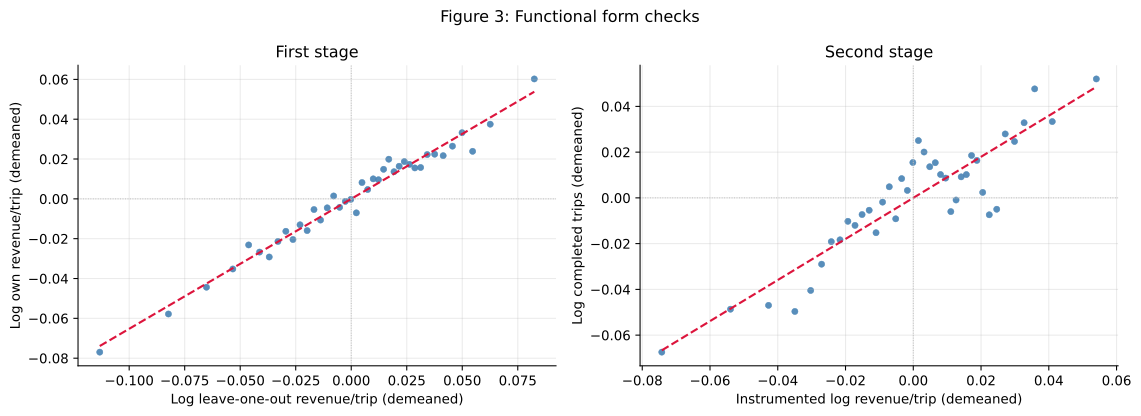
Finally, I confirm that the linear functional-form assumption in the log-log specification is appropriate. The following binned scatterplots show the first and second stages separately, along with a fitted OLS line. The first-stage plot shows a strong positive relationship between the instrument (leave-one-out revenue per trip) and the driver's own revenue per trip, confirming relevance. The second-stage plot shows a positive relationship between the instrumented revenue per trip and completed trips, consistent with the estimated elasticity.
def binscatter(x_values, y_values, ax, q=40, title='', xlabel='', ylabel='', color='steelblue'):
    plot_df = pd.DataFrame({'x': x_values, 'y': y_values}).replace([np.inf, -np.inf], np.nan).dropna()
    plot_df['bin'] = pd.qcut(plot_df['x'], q=q, duplicates='drop')
    binned = (
        plot_df.groupby('bin', observed=True)
        .agg(x=('x', 'mean'), y=('y', 'mean'))
        .reset_index(drop=True)
    )
    slope = float(np.polyfit(binned['x'], binned['y'], 1)[0])
    sns.scatterplot(data=binned, x='x', y='y', color=color, s=22, edgecolor=None, alpha=0.9, ax=ax)
    sns.regplot(
        data=binned, x='x', y='y', scatter=False, ci=None, color='crimson', ax=ax,
        line_kws={'lw': 1.6, 'ls': '--', 'label': f'Slope = {slope:.3f}'},
    )
    ax.axhline(0, color='#bbbbbb', lw=0.7, ls=':')
    ax.axvline(0, color='#bbbbbb', lw=0.7, ls=':')
    ax.set(title=title, xlabel=xlabel, ylabel=ylabel)
    handles, labels = ax.get_legend_handles_labels()
    if handles:
        ax.legend(handles, labels, fontsize=8)
    return slope

fig, (ax1, ax2) = plt.subplots(1, 2, figsize=(12, 4.4))
binscatter(
    full_spec['z'], full_spec['x'], ax1,
    title='First stage',
    xlabel='Log leave-one-out revenue/trip (demeaned)',
    ylabel='Log own revenue/trip (demeaned)',
)
binscatter(
    full_spec['x_hat'], full_spec['y'], ax2,
    title='Second stage',
    xlabel='Instrumented log revenue/trip (demeaned)',
    ylabel='Log completed trips (demeaned)',
)
fig.suptitle('Figure 3: Functional form checks')
fig.tight_layout()
fig.savefig(OUTPUTS / '03_binscatter_functional_form.svg', bbox_inches='tight')
plt.close(fig)
print('Figure saved: outputs/03_binscatter_functional_form.svg')
Figure saved: outputs/03_binscatter_functional_form.svg
3) Tiered Incentive Scheme
3.1 Tiered Design
We'll consider a simple tiered scheme that offers cash bonuses for reaching certain trip thresholds in a calendar week. This tiered reward structure is useful because it gives many drivers an attainable next milestone. A driver just below the first threshold can respond to a relatively small reward, while a more active driver may need a larger marginal reward to justify extra work.
The tier design also creates a simple operational lever. Instead of continuously changing prices, an operator can announce clear weekly trip thresholds and payouts, then evaluate how much additional supply appears around those thresholds.
3.2 Completed Trips as Incentivized Variable
I use completed trips as the incentivized variable. Completed trips are directly tied to passenger service, are easy to measure in the taxi records, and are harder to manipulate than logged-in time. A driver cannot accumulate trip progress simply by remaining available without serving passengers. The main gaming risk is that drivers could prefer shorter trips to reach thresholds faster. In taxis, this is partly limited because drivers generally cannot choose passenger destinations directly, but it can still be mitigated by excluding very short trips, setting minimum fare restrictions, and monitoring outcomes such as trip length, cancellations, and service quality.
3.3 Example
The following table summarizes the tiered incentive design for an exemplary calibration. I set the example thresholds at the 60th and 80th percentiles of completed weekly trips, rounded to the nearest value of 5, which are around 55 and 80, respectively. I let the first threshold offer a bonus equivalent to 5% of average retained fare earnings at the threshold, while the second threshold adds a marginal bonus calibrated so total retained earnings at the threshold rise by 10%. For simplicity, I assume that each taxi driver retains 50% of the fare revenue. Therefore, the marginal cash bonuses are approximately 40 and 75 USD, and a driver reaching Tier 2 receives 115 USD in total.
# Helper function: round to the closest multiple of 5
def round_to_5(value):
    return int(5 * np.round(value / 5))

# Setup
TIER1_EARNINGS_INCREASE = 0.05
TIER2_TOTAL_EARNINGS_INCREASE = 0.10

typical_revenue_per_trip = driver_week['weekly_earnings'].sum() / driver_week['weekly_trips'].sum()
driver_revenue_share = 0.5
driver_revenue_per_trip = typical_revenue_per_trip * driver_revenue_share

# Calculate trip thresholds: 60th and 80th quantile of weekly trips
threshold_1 = round_to_5(driver_week['weekly_trips'].quantile(0.60))
threshold_2 = round_to_5(driver_week['weekly_trips'].quantile(0.80))

# Calibrate marginal rewards: Tier 1 raises retained earnings at its threshold by 5%,
# Tier 2's marginal reward is set so total retained earnings at its threshold rise by 10%.
tier1_reward_pct = TIER1_EARNINGS_INCREASE
tier1_reward = round_to_5(threshold_1 * driver_revenue_per_trip * tier1_reward_pct)
tier2_reward_pct = (
    (threshold_2 * driver_revenue_per_trip * TIER2_TOTAL_EARNINGS_INCREASE) - tier1_reward
) / (threshold_2 * driver_revenue_per_trip)
tier2_reward = round_to_5(threshold_2 * driver_revenue_per_trip * tier2_reward_pct)

tier_table = pd.DataFrame({
    'Tier': ['Tier 1', 'Tier 2'],
    'Completed trips per week': [threshold_1, threshold_2],
    'Marginal bonus ($)': [tier1_reward, tier2_reward],
    'Total bonus ($)': [tier1_reward, tier1_reward + tier2_reward],
    'Total earnings increase at tier': [
        tier1_reward / (threshold_1 * driver_revenue_per_trip),
        (tier1_reward + tier2_reward) / (threshold_2 * driver_revenue_per_trip),
    ],
})
print(tier_table.to_string(index=False, formatters={'Total earnings increase at tier': '{:.1%}'.format}))
  Tier  Completed trips per week  Marginal bonus ($)  Total bonus ($) Total earnings increase at tier
Tier 1                        55                  40               40                            5.0%
Tier 2                        80                  75              115                            9.9%
3.4 Simulating Incentive Effects
Next, we can use the estimated supply elasticity from the previous section to simulate how many additional trips the tiered incentive scheme would generate. I assume drivers compare effective revenue per trip with and without the bonus. Reaching threshold $T$ that provides a marginal reward $R$ is equivalent to an effective percentage increase in revenue per trip of $R/(T \cdot r)$ over baseline revenue per trip $r$. Applying the estimated elasticity $\hat\varepsilon$, a driver currently completing $q_{pre}<T$ trips will increase supply to $T$ trips if:
$$ \begin{aligned} &q_{pre} + q_{pre} \cdot \left(\hat\varepsilon \cdot \frac{R}{T \cdot r}\right) \geq T \\ \Leftrightarrow \qquad &q_{pre} \geq \frac{T}{1 + \hat\varepsilon \cdot \frac{R}{T \cdot r}} \end{aligned} $$
Thus, each tier defines a lower bound on current weekly trips above which a driver is predicted to reach the next milestone. Drivers below the response window are left unchanged in this simple simulation. Applying this rule to our data, we estimate that driver-week observations with 53 and 54 trips would increase their supply to 55 trips, while those between 76 and 79 trips would increase to 80 trips. Overall, roughly 3,100 driver-week observations are predicted to reach the next threshold.
def simulate_two_tier_driver_week_frame(tiers, *, driver_week=driver_week):
    sim = driver_week.copy()
    sim['trips_post'] = sim['weekly_trips'].astype(float)

    # Apply the higher tier first so drivers close to Tier 2 are moved to the higher milestone.
    for t in sorted(tiers, key=lambda d: d['threshold'], reverse=True):
        mask = (sim['weekly_trips'] >= t['lower_bound']) & (sim['weekly_trips'] < t['threshold'])
        sim.loc[mask, 'trips_post'] = np.maximum(sim.loc[mask, 'trips_post'], t['threshold'])

    sim['bonus'] = 0.0
    for t in tiers:
        sim.loc[sim['trips_post'] >= t['threshold'], 'bonus'] += t['marginal_reward']

    return sim


def simulate_two_tier_incentive(
    tier1_threshold,
    tier2_threshold,
    tier1_reward_pct,
    tier2_reward_pct,
    *,
    driver_week=driver_week,
    elasticity=ELASTICITY,
    typical_revenue_per_trip=typical_revenue_per_trip,
    driver_revenue_share=driver_revenue_share,
):
    if tier2_threshold <= tier1_threshold:
        raise ValueError('tier2_threshold must be greater than tier1_threshold')

    driver_revenue_per_trip = typical_revenue_per_trip * driver_revenue_share
    tier1_reward = round_to_5(tier1_threshold * driver_revenue_per_trip * tier1_reward_pct)
    tier2_reward = round_to_5(tier2_threshold * driver_revenue_per_trip * tier2_reward_pct)

    tiers = [
        {
            'name': 'Tier 1',
            'threshold': tier1_threshold,
            'reward_pct': tier1_reward_pct,
            'marginal_reward': tier1_reward,
            'total_reward': tier1_reward,
        },
        {
            'name': 'Tier 2',
            'threshold': tier2_threshold,
            'reward_pct': tier2_reward_pct,
            'marginal_reward': tier2_reward,
            'total_reward': tier1_reward + tier2_reward,
        },
    ]

    for t in tiers:
        threshold_driver_earnings = t['threshold'] * driver_revenue_per_trip
        t['total_earnings_increase_at_threshold'] = t['total_reward'] / threshold_driver_earnings
        t['marginal_incentive_at_threshold'] = t['marginal_reward'] / threshold_driver_earnings
        t['lower_bound'] = t['threshold'] / (1 + elasticity * t['marginal_incentive_at_threshold'])

    sim = simulate_two_tier_driver_week_frame(tiers, driver_week=driver_week)

    base_trips = sim['weekly_trips'].sum()
    additional_trips = sim['trips_post'].sum() - base_trips
    additional_revenue = additional_trips * typical_revenue_per_trip * (1 - driver_revenue_share)
    total_bonus = sim['bonus'].sum()
    total_cost = total_bonus - additional_revenue
    total_cost_per_additional_trip = total_cost / additional_trips if additional_trips else np.nan

    return pd.Series({
        'base_trips': base_trips,
        'additional_trips': additional_trips,
        'additional_trips_pct': additional_trips / base_trips,
        'typical_revenue_per_trip': typical_revenue_per_trip,
        'driver_revenue_share': driver_revenue_share,
        'additional_company_revenue': additional_revenue,
        'total_bonus_paid': total_bonus,
        'net_program_cost': total_cost,
        'net_cost_per_additional_trip': total_cost_per_additional_trip,
        'tier1_threshold': tier1_threshold,
        'tier1_reward_pct': tier1_reward_pct,
        'tier1_marginal_reward': tier1_reward,
        'tier1_lower_bound': tiers[0]['lower_bound'],
        'tier1_total_reward': tiers[0]['total_reward'],
        'tier1_total_earnings_increase_at_threshold': tiers[0]['total_earnings_increase_at_threshold'],
        'tier2_threshold': tier2_threshold,
        'tier2_reward_pct': tier2_reward_pct,
        'tier2_marginal_reward': tier2_reward,
        'tier2_total_reward': tiers[1]['total_reward'],
        'tier2_lower_bound': tiers[1]['lower_bound'],
        'tier2_total_earnings_increase_at_threshold': tiers[1]['total_earnings_increase_at_threshold'],
    })


def tiers_from_simulation_result(result):
    return [
        {
            'name': 'Tier 1',
            'threshold': result['tier1_threshold'],
            'reward_pct': result['tier1_reward_pct'],
            'marginal_reward': result['tier1_marginal_reward'],
            'total_reward': result['tier1_total_reward'],
            'lower_bound': result['tier1_lower_bound'],
            'total_earnings_increase_at_threshold': result['tier1_total_earnings_increase_at_threshold'],
        },
        {
            'name': 'Tier 2',
            'threshold': result['tier2_threshold'],
            'reward_pct': result['tier2_reward_pct'],
            'marginal_reward': result['tier2_marginal_reward'],
            'total_reward': result['tier2_total_reward'],
            'lower_bound': result['tier2_lower_bound'],
            'total_earnings_increase_at_threshold': result['tier2_total_earnings_increase_at_threshold'],
        },
    ]
baseline_incentive_result = simulate_two_tier_incentive(
    threshold_1,
    threshold_2,
    tier1_reward_pct,
    tier2_reward_pct,
)
tiers = tiers_from_simulation_result(baseline_incentive_result)

print(f"Elasticity used for simulation: {ELASTICITY:.3f}")
print(f"Baseline wage per trip used for calibration: ${typical_revenue_per_trip * driver_revenue_share:.2f}")
print()
print(f"{'Tier':<8} {'Response window':<34}  {'Driver-weeks':>14}")
print('-' * 81)
for t in tiers:
    n = ((driver_week['weekly_trips'] >= t['lower_bound']) & (driver_week['weekly_trips'] < t['threshold'])).sum()
    print(
        f"{t['name']:<8} "
        f"[{t['lower_bound']:6.1f}, {t['threshold']:6.0f}) trips -> {t['threshold']:.0f} {n:>14,}"
    )
Elasticity used for simulation: 0.898
Baseline wage per trip used for calibration: $14.58

Tier     Response window                       Driver-weeks
---------------------------------------------------------------------------------
Tier 1   [  52.6,     55) trips -> 55          1,486
Tier 2   [  75.6,     80) trips -> 80          1,654
To estimate the business impact, we can calculate the number of additional trips, the additional fare revenue, and the total cost of the bonuses. I assume that additional trips generate the same average revenue per trip as the baseline, and that the non-driver share of that revenue is incremental company revenue before other operating costs.
Under this simulation, the incentive scheme generates around 6,400 additional trips across the historical driver-week sample, which corresponds to around $350 per additional trip.
base_trips = baseline_incentive_result['base_trips']
additional_trips = baseline_incentive_result['additional_trips']
base_revenue = base_trips * typical_revenue_per_trip
additional_revenue = baseline_incentive_result['additional_company_revenue']
total_bonus = baseline_incentive_result['total_bonus_paid']
total_cost = baseline_incentive_result['net_program_cost']
total_cost_per_additional_trip = baseline_incentive_result['net_cost_per_additional_trip']

# Print results
print(f'Additional trips:            {additional_trips:,.0f}     (+{additional_trips / base_trips:.2%})')
print(f'Additional revenue:          {additional_revenue:,.1f} (+{additional_revenue / base_revenue:.2%})')
print(f'Total bonus paid:           ${total_bonus:,.0f}')
print(f'Total program cost:         ${total_cost:,.0f}')
print(f'Cost per additional trip:   ${total_cost_per_additional_trip:,.2f}')

incentive_summary = baseline_incentive_result.rename_axis('metric').reset_index(name='value')
incentive_summary.to_csv(OUTPUTS / 'incentive_simulation_summary.csv', index=False)
Additional trips:            6,413     (+0.17%)
Additional revenue:          93,476.2 (+0.09%)
Total bonus paid:           $2,340,815
Total program cost:         $2,247,339
Cost per additional trip:   $350.43
4) Optimization
The current scheme is quite expensive, so let's see whether we can optimize it by adjusting the thresholds and rewards. We'll use a grid search over thresholds and reward percentages to find the combination that maximizes additional trips while keeping total program cost under $2,000,000. To keep things simple, we will only consider adjustments with two tiers.
threshold_grid = [50, 75, 100, 125, 150]
reward_pct_grid = [0.05, 0.10, 0.15]

optimization_records = []
for tier1_threshold in threshold_grid:
    for tier2_threshold in threshold_grid:
        if tier2_threshold <= tier1_threshold:
            continue
        for tier1_reward_pct in reward_pct_grid:
            for tier2_reward_pct in reward_pct_grid:
                optimization_records.append(
                    simulate_two_tier_incentive(
                        tier1_threshold,
                        tier2_threshold,
                        tier1_reward_pct,
                        tier2_reward_pct,
                    )
                )

optimization_results = pd.DataFrame(optimization_records)
optimization_results.to_csv(OUTPUTS / 'incentive_optimization_results.csv', index=False)

feasible_results = optimization_results[
    optimization_results['net_program_cost'] < 2_000_000
]
best_design = feasible_results.sort_values('additional_trips', ascending=False).iloc[0]
best_design.to_frame().T.to_csv(OUTPUTS / 'incentive_optimization_best_design.csv', index=False)

assert (optimization_results['tier2_threshold'] > optimization_results['tier1_threshold']).all()
assert best_design['net_program_cost'] < 2_000_000
assert feasible_results['additional_trips'].max() == best_design['additional_trips']
for fn in [
    'incentive_simulation_summary.csv',
    'incentive_optimization_results.csv',
    'incentive_optimization_best_design.csv',
]:
    assert (OUTPUTS / fn).exists()

print('Best feasible two-tier incentive design')
print('-' * 41)
print(f"Tier 1 threshold:           {best_design['tier1_threshold']:,.0f} trips")
print(f"Tier 2 threshold:           {best_design['tier2_threshold']:,.0f} trips")
print(f"Tier 1 reward percentage:   {best_design['tier1_reward_pct']:.0%}")
print(f"Tier 2 reward percentage:   {best_design['tier2_reward_pct']:.0%}")
print(f"Tier 1 marginal reward:    ${best_design['tier1_marginal_reward']:,.0f}")
print(f"Tier 2 marginal reward:    ${best_design['tier2_marginal_reward']:,.0f}")
print()
print(f"Additional trips:            {best_design['additional_trips']:,.0f}     (+{best_design['additional_trips_pct']:.2%})")
print(f"Additional revenue:          {best_design['additional_company_revenue']:,.1f} (+{best_design['additional_company_revenue'] / (best_design['base_trips'] * best_design['typical_revenue_per_trip']):.2%})")
print(f"Total bonus paid:           ${best_design['total_bonus_paid']:,.0f}")
print(f"Total program cost:         ${best_design['net_program_cost']:,.0f}")
print(f"Cost per additional trip:   ${best_design['net_cost_per_additional_trip']:,.2f}")
Best feasible two-tier incentive design
-----------------------------------------
Tier 1 threshold:           125 trips
Tier 2 threshold:           150 trips
Tier 1 reward percentage:   10%
Tier 2 reward percentage:   15%
Tier 1 marginal reward:    $180
Tier 2 marginal reward:    $330

Additional trips:            18,927     (+0.50%)
Additional revenue:          275,880.8 (+0.25%)
Total bonus paid:           $2,084,940
Total program cost:         $1,809,059
Cost per additional trip:   $95.58
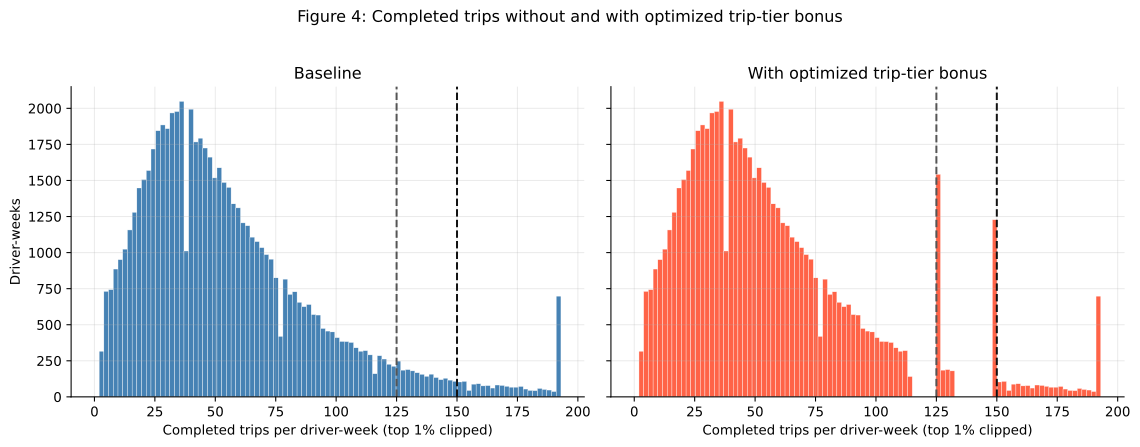
The best feasible design moves both thresholds deep into the right tail of the activity distribution (125 and 150 weekly trips) and offers larger marginal rewards of roughly 180 and 330 USD. This design generates around 18,900 additional trips across the historical driver-week sample, roughly three times the baseline scheme, at a net cost of roughly 96 USD per additional trip instead of 350 USD, while staying within the $2,000,000 budget.
Two forces drive this result. First, because the thresholds sit high in the distribution, far fewer driver-weeks already exceed them, so less bonus money goes to inframarginal drivers who would have reached the milestone anyway. Second, the absolute response scales with the threshold: for a given percentage reward, the response window covers a wider range of weekly trips, and each responding driver adds more trips when the milestone is higher.
To visualize the adjustment, we can plot the distribution of weekly trips before and after the optimized scheme. Because the thresholds sit high in the right tail, the response is concentrated among high-activity driver-weeks, with mass piling up at 125 and 150 trips.
best_tiers = tiers_from_simulation_result(best_design)
sim_best = simulate_two_tier_driver_week_frame(best_tiers, driver_week=driver_week)

plot_cap = sim_best[['weekly_trips', 'trips_post']].to_numpy().ravel()
plot_cap = np.nanquantile(plot_cap, 0.99)
bins = np.linspace(0, plot_cap, 100)

fig, (ax1, ax2) = plt.subplots(1, 2, figsize=(12, 4.5), sharey=True)
for ax, col, title, color in [
    (ax1, 'weekly_trips', 'Baseline', 'steelblue'),
    (ax2, 'trips_post', 'With optimized trip-tier bonus', 'tomato'),
]:
    plot_values = sim_best[col].clip(upper=plot_cap)
    ax.hist(plot_values, bins=bins, color=color, edgecolor='white', linewidth=0.25)
    for t, c in zip(best_tiers, ['#555555', '#111111']):
        ax.axvline(t['threshold'], color=c, lw=1.5, linestyle='--', label=f"{t['name']} ({t['threshold']:.0f} trips)")
    ax.set(xlabel='Completed trips per driver-week (top 1% clipped)', title=title)
ax1.set_ylabel('Driver-weeks')
fig.suptitle('Figure 4: Completed trips without and with optimized trip-tier bonus', y=1.03)
fig.tight_layout()
fig.savefig(OUTPUTS / '04_optimized_trip_tier_simulation.svg', bbox_inches='tight')
plt.close(fig)
print('Figure saved: outputs/04_optimized_trip_tier_simulation.svg')
Figure saved: outputs/04_optimized_trip_tier_simulation.svg
These numbers extrapolate a local elasticity estimate far into the right tail of the activity distribution, where responses may differ, for example because high-activity drivers are closer to their time constraints. In practice, the selected design should therefore be validated with a small-scale experiment before a full rollout.